
Whittlesey
Sax Choir
A community group for sax players
A community group for sax players
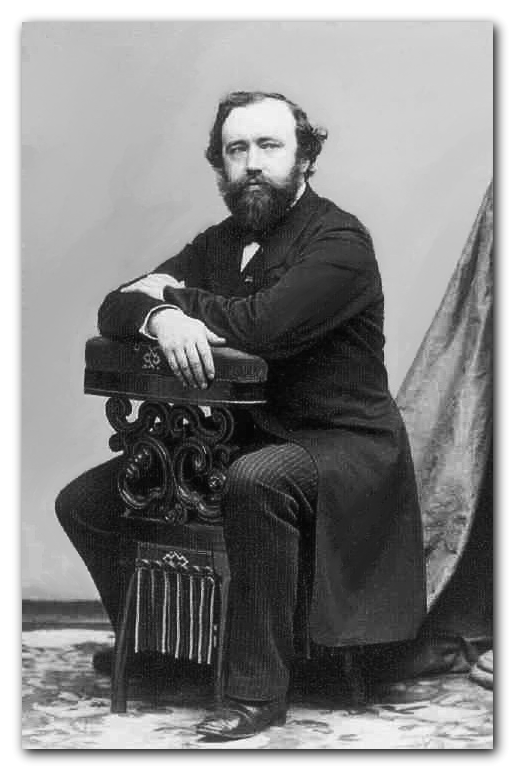 On 6th November 1814, Antoine Joseph Sax, known as Adolphe Sax, was born in Dinant, Belgium, the son of two instrument repairers and designers. He would go on to lead a life of both amazing achievements and near-calamitous misfortunes, but most importantly, to invent the saxophone.
Adolphe Sax was an accomplished musician but like his parents he couldn’t resist trying to improve on the instruments of the day. Even at the age of 15 he had made his own flutes and clarinets, and after graduating from Brussels Conservatoire as a performer on both, went on to make significant improvements to the bass clarinet design.
Not content with improving existing instruments, after moving to Paris and setting up his own workshop he started designing new families of wind instruments, covering the whole range of pitches needed for band and orchestral music. First among these were the “Saxhorns” in 1843, of which the Flugelhorn and the Eb Tenor Horn are the main surviving members. Later came the now forgotten “Saxotrombas” and “Saxtubas”.
In between creating these new brass families, Sax had also been working on a new type of woodwind instrument which he dubbed the “Saxophone”. With a wide conical bore it aimed to allow a woodwind player to have the projection of a brass instrument whilst being immediately playable by any flute or clarinet player. As with his brass instruments, this was designed as a family in various sizes. A prototype bass saxophone was demonstrated in the 1841 Belgian Exhibition of Industry Products, and a more complete version in a French Exhibition of 1844. He finally completed his designs and patented the whole family of saxophones on 21st March 1846.
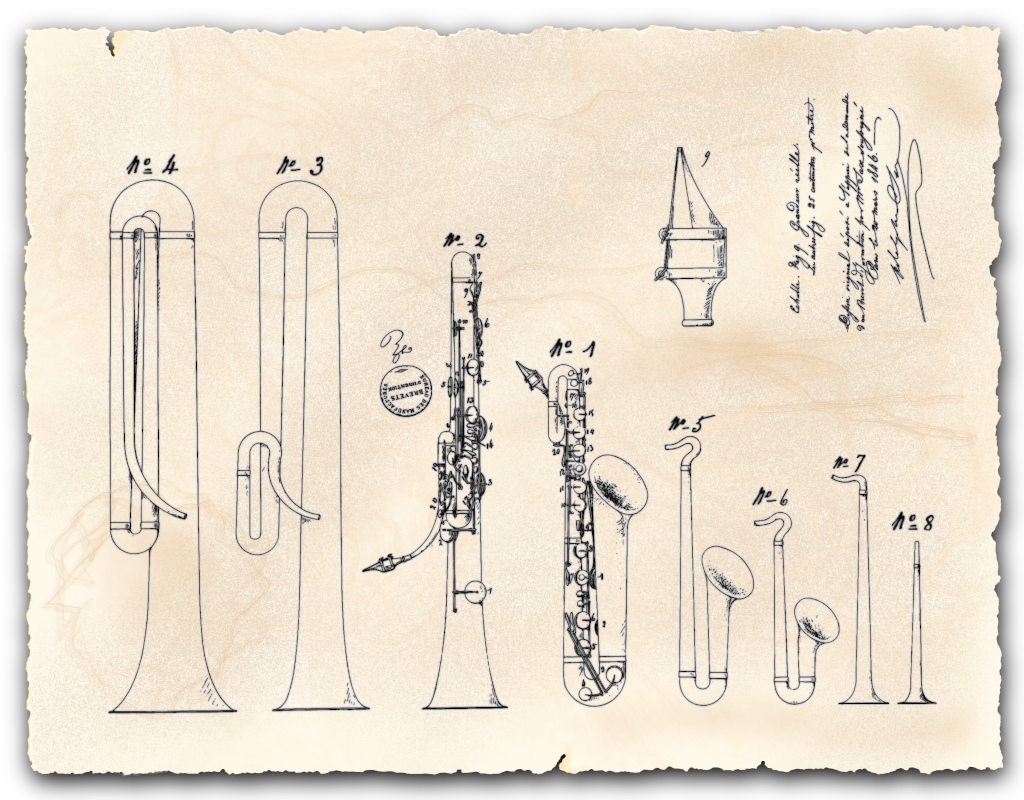
In the original patent Sax shows and describes eight saxophones. Perhaps showing his intention that these were primarily bass instruments, they are numbered:
Only the baritone and bass are shown with complete key-work, with the rest shown only in outline. The bass, contrabass, and bourdon (sub-contrabass) are all shown upside-down. They also feature bells pointing straight up rather than tipped forward as we are used to. The rest - baritone, tenor, alto, soprano, and sopranino - look much the same in this original design as they do today. Later lists would reduce this family to seven members, dropping the impractically large “saxophone bourdon” (4) which was never built in Sax’s lifetime.
The patent described two versions of each of these saxophones, the ones we know today in alternating keys of Bb and Eb, and variants one tone higher in the keys of C and F. The idea was that military bands would use the Bb and Eb versions to match other brass instruments already in use, and orchestras would use the C and F versions. When saxophones failed to gain any traction in orchestras, the C and F saxophones largely disappeared leaving us with the modern saxophone family:
.png)
Adolphe Sax and his inventions would go through many ups and downs, near disasters and bitter rivalries over subsequent decades. However those are stories for another day. For now we should just be thankful for this wonderful invention and celebrate that modern manufacturers have resurrected the saxophone bourdon (no 4), added a ninth member to the family: the sopranissimo (soprillo), and continue to improve and innovate just as Adolphe Sax would have done.
Written by Ben Tordoff, based on his lecture on the origins of the saxophone given at the Bate Collection of Musical Instruments, Oxford back in 2001. If this has piqued your interest, you can read more here:
and when you are next in or around Oxford, go and seek out the Bate Collection - it's a little tucked away but a fascinating place to spend an hour or two.